Thursday, 26 June 2014

The Good, The Bad & The Ugly

The Good

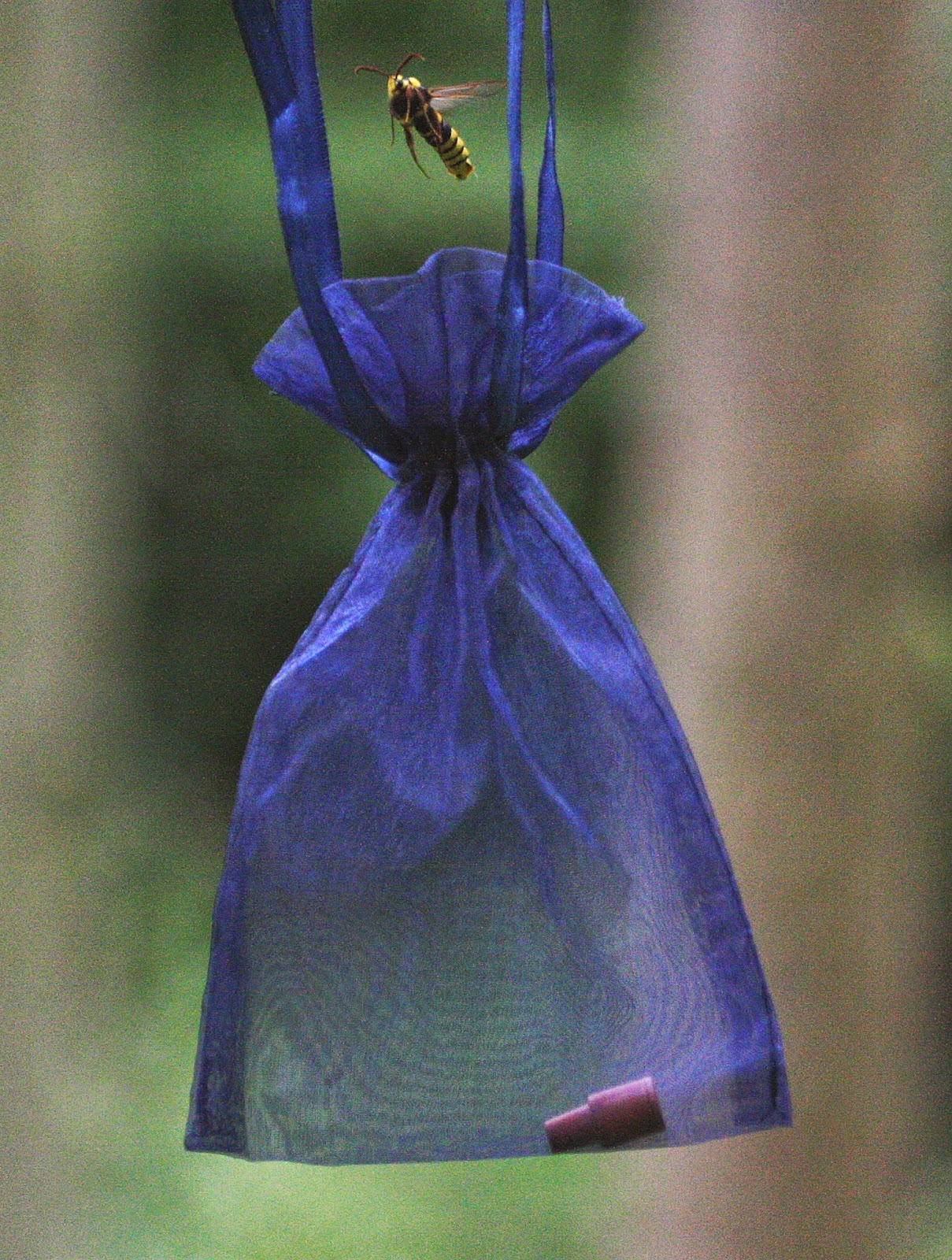
Last year my interest was captured when I saw a friend's photo on Facebook of some hornet clearwing moths at a pheromone lure in Suffolk. I'm not big into moths but 'twitched' a few hawkmoths back in the day, including a 260 mile round trip to the Norfolk coast for a Death's Head.

Fast forward to 2014 and I visited my local nature reserve, Fowlmere, with a lure purchased from Anglian Lepidopteran Supplies. It cost £7.50 and is species-specific; you can buy the 'classic 6' as a set for £35 and this covers most clearwing species. I might try for the others at some point, but meanwhile if anyone wants to do a swap...

The method is simple: Visit some poplars on a warm day with light breeze between mid May and mid June. Hang the lure and wait. And it was that simple. I attracted hornet clearwings at 3 out of the 4 spots I tried, and it only takes 5 - 10 minutes to bring them in. I had 3 or 4 females and one (much smaller) male. Enjoy the pics!



The Bad

There were some big ol' evil-looking mossies at the site, despite it being the middle of the day. They plagued me here and forced me to beat an early retreat but not before leaving me with a few fiercely itchy bites, one of which ballooned as I had an uncharacteristic allergic reaction to it next morning. I usually wear insect repellant if there are mosquitos about as I hate them with a vegeance, but putting on chemical insect repellant while standing by a chemical insect attractant - well it's not the brightest idea, is it?

The Ugly

Well the photo says it all. Here's me with my prize catch, just before release. On the other hand the insect itself, one of the larger females, is really quite beautiful.


Friday, 6 June 2014

Sexy Beast!

Firstly, if you have found this on a Google search and were hoping for a pic of Ray Winstone in his underwear, then I'm sorry to disappoint you. This post is about birds folks, and starts with one of the finest Avian offerings from the Mediterranean region (from a UK twitcher's perspective), a great big raptor with a staring yellow eye, vaguely osprey-like colour scheme and a penchant for snakes.

The popular eagle in Dorest last weekend was first found by someone on a guided walk in Wareham Forest. They pointed to the large raptor sat in a pine tree and enquired as to its identity. The guide, a local birder from Upton, Poole, must have nearly fainted. He recognised it as a short-toed eagle, and within an hour or so a fantastic photo was circulating on Twitter with the news that it had been present just 10 minutes, before heading off east.

I missed some 20 or so potentially new birds during my backpacking adventures downunder in 1999-2000 and though I have got back most of them since, the biggest prize - short-toed eagle - has never been
within reach. There have been a few claims since the first British record on Scilly in 1999, resulting in an accepted bird in Devon in 2011, and the fascinating unravelling in a classic Birdforum thread of
a hoax attempted by teenage birder Joe Pell - some excellent detective work paving the way for the now regular scrutiny given to suspicious online photos which might relate to a hoax, and which has produced experts in botany, fence posts and barbed wire that can smell a rat at a hundred paces from their laptop. Sherlock Holmes himself would be proud of some of the efforts in the 'Birdforum Courtroom' and to those that have helped expose such dubious goings on, I salute you.

Thoughts of a hoax were quickly dispelled however, when it emerged that other observers had seen this latest bird and that there had even been a possible sighting several days earlier. And the guide who put out the news had a solid reputation too, this was looking like the real deal! The hours passed, then suddenly there was another sighting nearby - the bird was lingering, and before I knew it came the best news of all - it had been relocated sitting in a tree!

Suddenly Dorset seemed a long way away from Cambridge, but despite leaving late in the day at 5.30, by 8pm I was watching it with just 35-40 or so birders, and these were mainly locals. Where was everyone?
It was a beautiful location and we watched the bird at a range of about a quarter of a mile, until the mosquitos and the need to find accommodation forced me to leave, though not before a nice flypast by a male nightjar.

A quick stay at a local YHA and I was back for seconds. It was a gorgeous day and several hundred people - containing many familiar faces - were watching the eagle.


 Med gulls passed over, and the air rang out with the song of tree pipits and Dartford warblers. The camararderie was good and soon everyone started to move closer. We eventually enjoyed views to just 150m range. The bird wasn't bothered at all. Then, just after 10am after a marathon 17 hrs sat (mostly) in the same tree it did the decent thing and took off to the onslaught of an army of firing camera shutters. It circled for a while and slipped away to the south west. It was not seen again. I returned home via the New Forest where distant goshawks and a single honey buzzard kept up the raptor theme. I was smiling most of the way. A ghost had been laid to rest!


Just the day after seeing the eagle I was off to Norfolk for my second spectacled warbler. I'd missed the female black-headed bunting in Norfolk, which had departed overnight after a stay of several days,
but you can't have everything. Norfolk listers had been denied the last 'speccy' in the county - a one day suppressed bird in 2011 on Scolt Head Island, so this one - destined to become the 8th record for Britain -  was very much appreciated.

It showed mainly in rose bushes at about 30 - 40m range, and delighted a whole new generation of birders who had not previously seen the species in Britain. It seems embarrassing now that despite having seen
10 Sylvia species in Norfolk (including such gems as Desert, Sardinian & Ruppell's) I have yet to catch up with Dartford warbler in the county!


Compared to the eagle, everything else in May paled into insignificance...sightings were unremarkable with perhaps the highlight for me a local pair of stilts on territory for a while - what became of them I'm not sure, and if I did know I may not be allowed to post the details. But with well-publicised pairs nesting this year in Kent & Sussex it's quite possible there are other breeding attempts going on elsewhere in the country. I might even take a trip down for the Kent ones as fluffballs elevated on stilts sound rather endearing.

A few ecology field surveys kept me busy, with particular focus on bats and great crested newts. At one site near the M25 we caught more than 50 of these, including 9 in one bottle trap. For a rare species GCN seems bloody common - but apparently their protected status reflects more on their rarity across Europe as a whole, though perhaps it's partly down to new taxonomy with new species such as Italian crested newt now split and presumable rendering GCN rarer and more restricted on the continent. Anyway, not a subject I can pretend to know much about, though training for a newt license could be on the cards for next year - watch this space.


With the highlight of the bat surveys being a little owl (or two) it was left to a couple of trapping sessions with local bat groups to produce true Chiropteran inspiration - sessions at Finemere Wood, and Priory CP yielded a succession of the commoner species (both pips plus Daubenton's) in the hand along with 2 individuals of the rather rare Bechstein's bat - complete with attendant film crew from Countryfile. The latter made it (at times) difficult to get near the tiny stars of the show but good views of the delectable Ellie Harrison made up in part. On this occasion I chose to stand well behind the cameras - just in case someone thought I actually knew something about bats!

Bechstein's bat
Common pipistrelle
Soprano pipistrelle

Saturday, 3 May 2014

Another Fair Isle Double!

The second half of April 2014 was spiced up with a few birding sojourns close to home. A day out in the Brecks produced a few of the region's specialities and views of the male two-barred crossbill at Lynford; a mini twitch to the Cam Washes yielded a pair of red-rumped swallows, my first multiple of this species in Britain; a half day at the Ouse Washes produced a few migrants and some decent passage waders; and a trip out to Baldock produced a fine male 3rd calendar year hen harrier, albeit not the Monty's it had been I/D'd as prior to my visit.

The first big bird of the spring often breaks around the end of April or beginning of May. We've already had this in the form of the excellent crag martin at Flamborough. The next biggie was to be an island job, Fair Isle to be precise, a location temporarily home to a fine male Cretzschmar's bunting, and like the martin, a massive potential grip-back for me!

There has been just one truly twitchable Cretzschmar's, one for 3 days on North Ron a few years ago, a bird likely to have generated more spelling mistakes in birders' notebooks than perhaps any other. All records have come from the Northern Isles, making it a much prized rarity indeed. This latest Cretz was not a bird to miss, not least because there was some serious back-up material on the island in the form of a fine male Caspian stonechat, a potential new bird for me and a likely future split. And like the bunting it would represent just the fifth record for Britain. It could be just like the Fair Isle double of 2003 when I went for a savannah sparrow and collected my second Sibe rubythroat into the bargain.

This mega bunting was found by ex-warden Deryk Shaw while checking out an RB fly just opposite his own croft. These 2 two birds, together with the stonechat, has taken his 'garden' list to over 150, a list truly rich in terms of quantity yet even more impressive in quality, but that's Fair Isle for you!

Luckily news of the bunting's continued presence broke early on the day I travelled, enabling us to have most of the day on the island. The ever-accommodating obs staff collected us and delivered us to a damp field in the south of the island at Boini Mire. Here the bunting was showing on and off in long tussocky grass. It wasn't particularly close (perhaps 70 – 80 yards) but was a right stunner in a gorgeous orange and blue colour scheme, much brighter than any male ortolan.


With the stonechat just a five minute walk along the road at Lower Leough, we soon headed off to look for it and found it showing like a dream, sometimes down to just a few metres, sporting that great wheatear-esque tail and a handful of other diagnostic features. What a day this was turning into! Birders soon drifted off to check out a couple of nearby short-toed larks, leaving me with the stonechat virtually to myself.


I eventually tore myself away and returned to Boini Mire but the bunting had moved on. I stayed in the general area, checking out a few nearby crofts and fencelines, but couldn't relocate it. I decided not to try for the nearby larks which was perhaps a bad decision, as I heard later that they had been showing well and there was a wryneck close-by too. I also somehow missed Deryk's RB fly, and was later gripped off by some stunning photos. Instead I rambled around checking out the commoner migrants – a few tree pipits were much in evidence among the dozens of meadow; there was a smart male redstart and equally smart male whinchat; lesser whitethroat, white wagtail, brambling and a fly-by redpoll provided further interest.


Around lunch-time I had brief views of the bunting as it flew by me, giving its fairly distinctive 'wip, wip' call, but I immediately lost it to view and couldn't refind it. I continued searching for another hour or two, and managed to kick up a jack snipe and blue-headed wagtail from a ditch in the same field but all too quickly it was time to head home and I was left reflecting on what had been quite a day, one on which Fair Isle yet again had proven that when it comes to rare vagrant birds, there really is nowhere better.


Thursday, 17 April 2014

Mega City!

The past week or so has been particularly rewarding birding-wise with three MEGAs and some excellent back-up birds to boot. First up was an osprey - nothing mega about that you might think but its location, in the skies above my house, instantly promoted it to 'monster' status. Yes, a house tick and one of the best birds I've ever had from my humble abode with its tiny garden and general lack of interesting habitat for miles around. YET - it's my 8th raptor species here and furthermore the last 3 house/ garden ticks have been in a league of their own. Just a week before the osprey I was going through some pics of redpolls that had been visiting my feeder last winter - one was quite clearly a mealy! Not sure how I missed it at the time, but there's no question as to its I/D. The other five star bird from last winter was waxwing, with a number of birds which visited on 4 separate occasions and got me grinning from ear to ear.


mealy redpoll - retrospective identification!

A look at my first pied-billed grebe for 15 years was next on the agenda when I was offered a lift for one at Rutland Water, a locality tantalisingly close to Cambridgeshire on a very typical date for an arrival of this rare yank. The bird was present just 2 days so I was lucky to see it on its second. I went with Brendan and together we arrived rather late, with a longer walk than expected. We had views to around 100 metres, with a summer plumaged great northern diver and a single osprey providing distractions from the star bird.


After missing the 1999 crag martin in the Midlands/ Yorkshire (I was in New Zealand and I wasn’t confident I could get to it in time, it being an unpredictable hirundine n’ all) I was delighted to hear last week of the presence of one at Flamborough, though somewhat dismayed to realise that news had broken some two hours before I knew anything of it! I had Ben for the morning so I may not have been able to go but still…thtat's amateurish!

I hastily laid plans and decided to hot foot it north without trying to fill the car. I just wanted to be there as soon as possible. But I was still behind with news and it took a long time for news to come through to me that it had done a bunk. By this time I was just an hour away and I decided to divert to Hornsea Mere, aware of how the last bird had shown up at reservoirs and gravel pits.

As I drove in to the car park a female mallard was being gang-raped by a bunch of drakes. I broke up the party a couple of times but my efforts were futile and their efforts immediately resumed. Here I met Will Soar and we spent the rest of the afternoon checking the hirundines, with 150+ sand martin present and up to 3 swallows. A black swan, female long-tailed duck & velvet scoter along with a pair of tree sparrows and 40+ goldeneye and a sleeping fox provided welcome distractions but there was no sign of the martin.


non-crag martin
After some local fish and chips we headed to the Crown & Anchor pub in Kilnsea where we joined Ash Howe and headed onwards to the Warren at Spurn where we spent the night.

We were up at 6 and vis-migging all morning, hoping for a lucky flyover. A few migrants appeared – little tern, whimbrel, wheatear, LRP and a handful of hirundines, mainly swallows, but still no martin. The other 2 left at 11am, just 20 minutes before a serin flew over – excellent for me but unlucky for them. That was to be my lucky flyover but 20 minutes after I left, it apparently returned to the obs and showed well in the bushes along with a 2nd bird – it was my turn to feel gripped off when I saw the photo later on Twitter.

sunrise at Spurn

flyover serin - honest!
With no crag martin sightings for some 24 hrs I headed for home but was stopped in my tracks roughly half way by the news the martin had been sighted again, still in the area of Flamborough Head, though it had been lost to view. I waited at the services for more news. It came. I burned rubber and the VTEC engine system on my trusty Honda Civic Type-R got me to Flamborough in record time. True birding in the fast lane!

As I neared Flamborough it started to rain. This was not good news and I was convinced I'd miss the bird. But on arrival it was showing well at North Landing and soon afterwards was swooping over our heads, sometimes just 3 or 4 metres away - bloody awesome, and 15 years of hurt instantly evaporated!

crag martin!


Last birding trip of the period was one made after work to the Ouse Washes. One particular site near Pymore has racked up an extraordinary collection of rarities in recent weeks, including a drake green-winged teal which was my target on this visit. I joined Nene Washes warden Jon Taylor and started scrutinising a tiny flooded dyke in the distance, the only water for miles around. The light and distance involved made for tough viewing but eventually a rare teal did materialise - but despite being a drake with a white vertical stripe between the breast and flank it wasn't the green-winged, it was the relocating drake Baikal from Fen Drayton! Soon afterwards the GWT appeared, trying to impress the female teal with its head-bobbing display. There wasn't time to search for the nearby great white egret or American wigeon and apparently the following day a pair of glossy ibises and a ruddy shelduck were present on the same area of water as the teal, and a day later still, a cattle egret showed up nearby at the Welches Dam reserve. A real purple patch for one of the best birding sites in this part of the country - As Arnie once said - 'I'll be back!'

That lil' bit o' water - Rarity Central!


Monday, 7 April 2014

Tale of a Teal and a Perplexing Pipit Puzzle

Since my last update I’ve seen a few bits n’ bobs. The dusky warbler in Suffolk – an elusive little thing, I was surprised to see it on arrival, but failed to get decent views in the 3.5 hours I waited.

 
Then there was the teal. A drake Baikal in fact, just 20 minutes from home. It was found on a WeBs count a fortnight earlier and news wasn’t released at the time as it was assumed to be an escape. But when Mike Everett came across it and put the news on the Cambirds Google Group it was MEGA’d by the info services – ensuring it was taken seriously by the birding community.

I was in London when news broke but got it at last light, having spent an hour trying to find the right spot on a right wild goose chase – or should I say plastic duck chase? Who knows where it’s from, but with the species now firmly established in Cat A of the British list I don’t see why this one won’t be given the benefit of the doubt.

Anyway I had a MEGA on one of my local patches so was happy to give it the benefit of the doubt, returning a few days later for seconds. These two trips gave me my first migrants of the year (garganey & sand martin though I’d also had a few singing chiffs and blackcaps prior to this) and some notable mammals – badger and weasel crossed the road in front of my car on the outskirts of nearby villages and a large bat was hunting over the guided busway close to where I’d parked on my first visit. It could have been a noctule but was inaudible and quite low-flying (and possibly not quite big enough) leaving me with thoughts of Leisler’s. I returned with a bat detector on my second visit but couldn’t relocate it, neither did I notice the nearby mink, which was apparently lying freshly dead on the busway just yards from where I parked.

A quick stop at Connaught Water a few days later failed to produce the hoped-for smew (and no mandarins either) but there was a nice sinensis cormorant in breeding plumage.

continental cormorant (sinensis), Connaught Water

I don’t usually check these but as this one was conveniently close with an obvious whitish head and some deep orange bare facial skin I thought it would be a continental one so grabbed a passing shot, one that shows the correct shape of facial skin for this form, with the rear border falling at roughly a right-angle to the gape-line. A useful plate illustrating this difference can be seen here http://www.irishbirding.com/birds/web/Display/sighting/48370/Continental_Cormorant.html


Yesterday I headed to the Ouse Washes for a few hours. The Washes were graced with typically good numbers of birds – 2 pairs of garganey, 50+ ruff, a few hundred black’wits and at least 80 pintail were all noteworthy. A spoonbill over the back (present since the previous day) represents only my second county record, and a flyover yellow wag was my first of the year.


And then I came across this pipit.

 
I’ve had some tricky gulls to sort out recently but passerines have generally been straightforward. Not so the small blushing pipit creeping about near Welches Dam Hide. It was on its own and so was I. And I didn’t know what it was. It spent much of its time part hidden in the vegetation in windy conditions and took on different appearances as the sun peeped in and out of the clouds; I went from water pipit to Littoralis rock but it was clearly neither of these, and I was forced to consider other options – coutelli water pipit and Siberian buff-bellied (spp japonicus) can both show similar toned underparts to this bird but I’m not that familiar with them, though I knew the whole rock-water-buff-bellied pipit complex consisted of birds with plain mantles, unlike the one I was watching. I knew meadow pipit can sometimes be rather pinky-orange below, but this bird had a grey head, too, though several other features seemed to fit meadow pipit. It was time to get some photos and sort it out afterwards.

Aberrant meadow pipit ('whistleri-type' or erythristic), Ouse Washes

Aberrant meadow pipit ('whistleri-type' or erythristic), Ouse Washes

Aberrant meadow pipit ('whistleri-type' or erythristic), Ouse Washes

Aberrant meadow pipit ('whistleri-type' or erythristic), Ouse Washes

Aberrant meadow pipit ('whistleri-type' or erythristic), Ouse Washes
 After doing some reading up at home I was happy the bird was an aberrant meadow pipit, one of the ‘funny’ ones occasionally misidentified as red-throated pipit and regularly attributed to the claimed Irish & Hebridean race whistleri, but possibly just an erythristic (excess red pigment) form of nominate pratensis. Among the features which indicate this bird is a meadow pipit are the small pale bill, virtually complete white eye-ring only broken marginally at either end (more obviously in front of the eye in rock/ water-types), clean cut black streaking below, heavily streaked mantle, streaked crown, indistinct supercilium and pale legs. Its call seemed less squeaky than a normal mipit's and it didn't call on take-off. It shows moult contrast on the greater coverts but I think this can be shown by both young and older birds, rendering ageing perhaps unsafe at this time of year. Of note is the fact that the pinky-buff of the underparts is echoed throughout the bird's plumage forming the ground colour of the mantle and also showing through on the grey of the head. Could this be more suggestive of a pigment condition perhaps? Personally I'm not sure I buy the whistleri theory - only a tiny proportion of whistleri look anything other than nominate pratensis and some individuals seen elsewhere (eg here) have been in heavy moult and perhaps more local in origin than from the Celtic West. 'Whistleri' is however a good search term for Googling if you are wanting to see more pics of these birds. There is a marked peak in records in March and April and this bird fits the pattern neatly - what are they and where have they come from? We may yet find out. For another at this time of year in Cambridgeshire (from 2006) see here. 

A couple of my own pics taken in the Hebs last year appear below and show just how similar most birds are to nominate pratensis. For further reading see Richard Porter's article on these aberrant type meadow pipits in Birding World (2005) with particular reference to one photographed on Blakeney Point.

meadow pipit (pres race whistleri), Harris (August 2013)

meadow pipit (pres race whistleri), Harris (August 2013)
 And to finish with I noticed this pair of great tits at my garden feeder this morning. The female is very washed out - they're like chalk & cheese! Could this be down to simple variation? The colours are similar to some juvs I seen but it's too early for a juvenile and there's no yellow flanges. I've seen some odd great tits before, including a couple of melanistic-looking ones in the Midlands. Or perhaps it could even be a bird of eastern origin? Comments welcome! 


References
Porter R. 2005 Birding World Volume 18 number 4