Monday, 20 October 2014

SHETLAND! Part 1 Days 1-3

Shetland is quite simply THE best place in Britain to see rare birds. Every year on Birdforum there is a thread comparing its birds with those turning up on Scilly. Every year (almost) there is no contest. During the month of October, Scilly was the traditional holiday destination for birders in the eighties and nineties. Now numbers of visiting birders have dropped off, as the islands have priced themselves out of the market whilst delivering fewer good birds. It's a viscious circle, with fewer visitors resulting in fewer rare birds found, which in turn puts off more birders from visiting. Shetland however is becoming increasingly popular and a similar process applies in reverse.

I did Shetland in the spring of 1998 and had a week on Fair Isle in 2002. This was to be my first Autumn trip based on Shetland mainland. And so it came to pass that on the evening of 2nd October I was picked up at home by Andrew Lawson (hereafter known as Marcus just to piss him off) and in the company of George Kinnard (hereafter known as Young George or George the Younger) and celebrity birder Gary Bagnell (hereafter known as Baggers) we headed north in search of feathered waifs and strays that would hail from the far off land of Siberia - or so we hoped.

Day 1

The morning of 3rd saw us scouring the scoter flocks off Blackdog near Aberdeen. With no obvious surfers present we headed to the Ythan Estuary where a good variety of waders and wildfowl kept us entertained. Baggers found a Slav grebe and the stakes were upped further when we found a rather  elusive yellow-browed warbler on the north side on the edge of the Sands of Forvie nature reserve. A good start to the trip but we wanted those scoters so headed back South and tried again, this time off Murcar Golf Course. 

We scrutinised the distant bobbing dots on the water and after some time Marcus picked out a male SURF SCOTER. Nice! We closed down the distance and I eventually got some rather poor record shots. Well, it was about a third of a mile out! After prolonged observation it became apparent there was a female-type in attendance - an educational bird at that range, sporting a compact look when compared to the neighbouring velvet scoters, along with a squarer head shape and less concave head and bill profile. Job done. We left feeling satisfied and headed for the boat. Things were really looking up. Dan Pointon had just found a rubythroat about 3 miles from where we staying on Shetland. Thanks Dan, that would do nicely as a starter!

f/imm surf scoter

pair surf scoters
Day 2

It was an uneventful crossing on which for some reason I awoke at 3am and couldn't get back to sleep. On arrival we went straight to Levenwick for the SIBERIAN RUBYTHROAT which was still present. Now to say this bird was a bastard to see would be an understatement. In fact it took me nearly 7 hours waiting to get a view and it rained the whole time. Luckily my waterproofs held out and we then had the luxury of a car ride as far as Tingwall Airport where a juv PALLID HARRIER was showing, often hunting around the runway. From there we returned to Levenwick and stuck it out until dusk by which time we must have been there about 9 hrs in total. All this for a bird I've seen twice before in Britain. But then a rubythroat isn't just any bird, now, is it?
 
 
Day 3

With a big storm approaching the wind started to get up on day 3 - a freshening SSW blow which gradually moved round to a southerly. We were becoming increasingly excited as the storm would bring SE gales, conditions sure to bring in good birds. The price we would pay for this would be a couple of days where the weather would be extreme enough so as to be 'unbirdable'; but for now we could get out into the field. We headed again to Levenwick where again we struggled to see the star bird. We were spread out around a garden with three vantage points that gave observers a chance of a glimpse. But when around lunch time we realised there had been no sightings for some two hours or so it was time to question whether it was even still in the same garden or not. We needed a break and repeated our move of the previous day, heading again for the PALLID HARRIER at Tingwall. This gave similar views to those of the previous day but this time there was an added bonus nearby - a HORNEMANN'S ARCTIC REDPOLL at Veensgarth.
Arctic redpoll race hornemanni (prob 1st wint f), Veensgarth
The redpoll was duly collected though it was considerably less 'classic' than the only other I'd seen, at Aldeburgh, Suffolk. Some people leaving as we arrived remarked on this and I too initially had doubts. My first view of it came when I put it up with two mealies round the back of the willows - it looked the same size as them! But it did have the distinct contrasting golden-buff hood so characteristic of 1st winter Hornemann's and it seems likely it's just a small one after all, rather than an exilipes as some of us had started to consider.

We were still after that second rubythroat fix and when the news filtered through it had been refound in another garden half a mile or so from the original one, it was with renewed optimism we headed back South to Levenwick. Here, after a bit of a wait, we had slightly better views but birders were tightly packed in at the bottom of the drive and it was difficult to be in the best place for viewing.

We headed off and decided to check Boddam. We'd done enough twitching and it was time we started to find our own birds. We split up and I left the road, heading up a short track which came to an end just before some houses. What took me up that path I'm not sure but it was a good move. Near the end, a small bird came out of the long grass and circled round behind me. It didn't call but it looked like a small bunting!! Luckily it landed on the path 30 - 40 yards behind me and I raised my bins. A little chestnut face met my gaze and I thought I could even just make out an eye-ring. A LITTLE BUNTING!  A good find for so early in the trip, I knew the others would want to get a look at this. I'd left my radio in the car and found to my dismay my phone battery was dead. Luckily Young George was approaching along the road and I signalled to him there was something good on the path. Within minutes all 4 of us had converged and had good views. We put out the news and as a few birders (filthy twitchers!) started arriving, we headed south with a new-found confidence. What else was out there still to be found was anybody's guess. 
Little bunting, Boddam (photo Paul Hawkins)
Little bunting, Boddam (JH)

We spent the rest of the day working various sites near Sumburgh and seeing a few noteworthy birds including great northern diver, YBW, merlin, jack snipe, barnacle goose, arctic tern and brambling. Then it was back to our (somewhat cramped) digs at Sandwick for a relaxing evening and speculation on what the coming weather might bring in.

Would Premiereship twitcher Baggers be caught off-side for a rarity down south? If there was a fall to remember the next day would it be Scandanavian migrants or Baggers coming off worse after taking on a barbed wire fence? Or would the only productive winds here be those originating from Marcus? And would being with three ol' codgers talking about the good old days eventually drive George the Younger insane and cause him to give up birding for good? To be continued...


Tuesday, 23 September 2014

Ghostly Blonde Brock Shock and a Bat Extravaganza

 I only have time for a quick write-up but here are some pics from an epic night catching bats of several species during a swarming survey – we worked from dusk through til around 4am and caught something like 170 bats of nine species. I didn’t get home 'til 6.15am! But the biggest surprise came on the way back, when I had a glimpse of a most unusual mammal disappearing into roadside vegetation – it appeared to be a ‘golden’ or albino badger! Just wish I had seen it for longer, my tired eyes having been slow to pick up on it crossing the road. But I definitely wasn’t hallucinating. Just minutes later I slammed on my brakes to avoid a fox. Had this have been a weird colour I would have been questioning my eyesight but it looked pretty regular!
 

Above from top: Brandt's, Bechstein's & Natterer's bat


soprano pip
Next outing the following weekend was another one for bats. I really have done a lot of bat stuff this year. And so far this autumn it's been mainly at the expense of birding, though there has been little in the way of temptation, with only one big bird (masked shrike) managing to draw the masses.

 
I didn't go for the shrike and the day it was found I was checking bat boxes at Southey Wood. It was a still, murky day brightened up by the sound of a raven passing over (still very scarce in the county though less so in this particular corner of it on account of breeding birds just over the nearby Northants border), and we moved from tree to tree checking on the occupants of some 50 bat boxes in the wood. The expected soprano pipistrelles were found but I was really hoping for a Leisler's. I was in luck. Around 30 boxes into the check, a pair of these 'lesser noctules' were pulled from a box. Twice the size of the pips and clearly noctule-like but a little smaller with drabber, less silky fur, this duo provided with me first close-up views of Leisler's, my 13th bat species this year. 
Leisler's bat

Friday, 15 August 2014

Birds, Bats, Bugs & Butterflies

The Mid-Summer Lull? What’s that? The few weeks between the two main migration periods can be a quiet time for birders, but not if you’re into other forms of natural history. It’s been a few weeks now since my last post but plenty has been happening!

THE BIRDS
Rarest bird I've seen recently has been a BLACK-WINGED PRATINCOLE on the Ouse Washes. This bird has been tracked down the east coast and everywhere it has been erratic and unpredictable in its appearances. So too in Cambs, and it was only on my second attempt that I saw it. I waived the 5 mile round walk in favour of a 50 yard one to and from my viewpoint on the other side of the washes. It was more distant, but all the features were visible.
 
BLACK-WINGED STILTS have had an incredible year with successful breeding at multiple sites. One was just half an hour from home (assuming this was the actual breeding site, must try to find out) so after the first pratincole attempt I dodged the thunderstorms and headed to Cavenham Heath where I saw the whole stilt family – both parents and 4 juveniles. Awesome stuff.
Two of Britain’s most elusive birds breed in Cambs and I was lucky enough to see both this summer. Singing quail regularly occur within a few miles of my home, but I’ve never seen them, until this year! Persistence paid off with sightings of 2 different individuals (one was actually in Herts). Corncrakes are also shy and retiring but I joined a trapping session at the Nene Washes with the RSPB and we got lucky. We spent 2.5 hrs working a stretch of overgrown bank making lots of noise and eventually herded no less than 8 into the traps. The best catch this year apparently and half were wild born birds – a single juvenile and a female with 2 chicks, the latter 2nd generation wild corncrakes. With the releases now over, they’re on their own, but it’s great to see successful breeding taking place.
common quail


BATS
I joined a couple of harp trapping sessions and among the selection of pips and Daubenton's were a couple of rarer bats – a female whiskered and a well-hung male NATHUSIUS'S PIPISTRELLE. The latter species is the subject of a national survey this year. Though it was only discovered in Britain in the nineties it is now thought to be so widespread it has been recorded from almost every English county and has an affinity for large water bodies. It is a migrant, probably most numerous in the autumn but there appear to be resident populations too and some which hibernate here which may have travelled from the continent. A recent ringing recovery of a Somerset-rung Nathusius' was made in Holland! This particular bat had very large swollen 'bits' so was in prime breeding condition. The bat regulars got rather excited by his inflated genitalia – oo er, missus! 
whiskered bat enjoying the joke we'd just told it

Nathusius's pipistrelle
BUGS
I rarely show too much interest in anything smaller than a butterfly but a few interesting bugs caught my attention during the period. One is a tiny mayfly, not more than a few mm long, which landed on my hand one evening while I was watching the stilts at Cavenham. I fancied it might be something new to science and thought about naming it Hanlon's Flying Fish Mayflything – see the resemblance from the photo? (to a flying fish, not to me). It turned out to be Caenis horaria, certainly a little beast I've never noticed before!
Violet ground beetle

golden-bloomed grey longhorn Agapanthia villosoviridescens


Caenis horaria (photo by Lee Gregory)
BUTTERFLIES
Since last year strange things have been happening in the butterfly world. There has been a remarkable influx of long-tailed blues (some staying to breed) and this year a colony of maps were discovered in Dorset. A meadow fritillary was recently seen near Milton Keynes and gorganus (Continental) swallowtails invaded the south coast in 2014 and also appear to have bred. Many of these are likely to be the result of releases from captivity but not all. The highlight for many has been an unprecedented influx of (undoubtedly wild) SCARCE or YELLOW-LEGGED TORTOISESHELLS, continental butterflies which recently colonised Finland and have only been recorded in the UK once previously. They appeared this year for the first time in Holland, in their hundreds. After reading about this I suddenly remembered seeing a couple of reports of large tortoiseshells in East Anglia earlier in the day and remembering they were very similar in appearance I tweeted the staff at Minsmere raising the possibility that their 'large tort' might be something rarer! The following day they checked photos and saw the butterfly again – it was a scarce! More east coast sightings followed but the Minsmere individual had disappeared by the following day when I headed up to Breydon for the great knot. The wader it turned out had departed and I found myself just short of Norwich wondering where to go.
As it turned out I was just 10 miles from Costessey, where another of this species had been identified the previous day. But being just 2 miles from the site of a mass release of butterflies during a funeral the previous week, the possibility of a wild origin had been 'written off' by many, including me. But with more turning up around the coast it started to dawn on me that the release may have just been a coincidence.
I headed to Costessey and after an hour or so of searching, relocated the tortoiseshell, which proceeded to sit up on a tree trunk for the best part of an hour. A few locals managed to twitch it and it was eventually seen by around 50 people, most of which had turned up on spec hoping for a sighting. It would have been seen by more had the butterfly stuck around but it soon headed off towards the large pond nearby and despite further searching, was never seen again. For now the sightings of scarce torts has died down but I don't think this is the last we'll see of this species in the UK.
scarce tortoiseshell

scarce tortoiseshell


Thursday, 26 June 2014

The Good, The Bad & The Ugly

The Good

Last year my interest was captured when I saw a friend's photo on Facebook of some hornet clearwing moths at a pheromone lure in Suffolk. I'm not big into moths but 'twitched' a few hawkmoths back in the day, including a 260 mile round trip to the Norfolk coast for a Death's Head.

Fast forward to 2014 and I visited my local nature reserve, Fowlmere, with a lure purchased from Anglian Lepidopteran Supplies. It cost £7.50 and is species-specific; you can buy the 'classic 6' as a set for £35 and this covers most clearwing species. I might try for the others at some point, but meanwhile if anyone wants to do a swap...

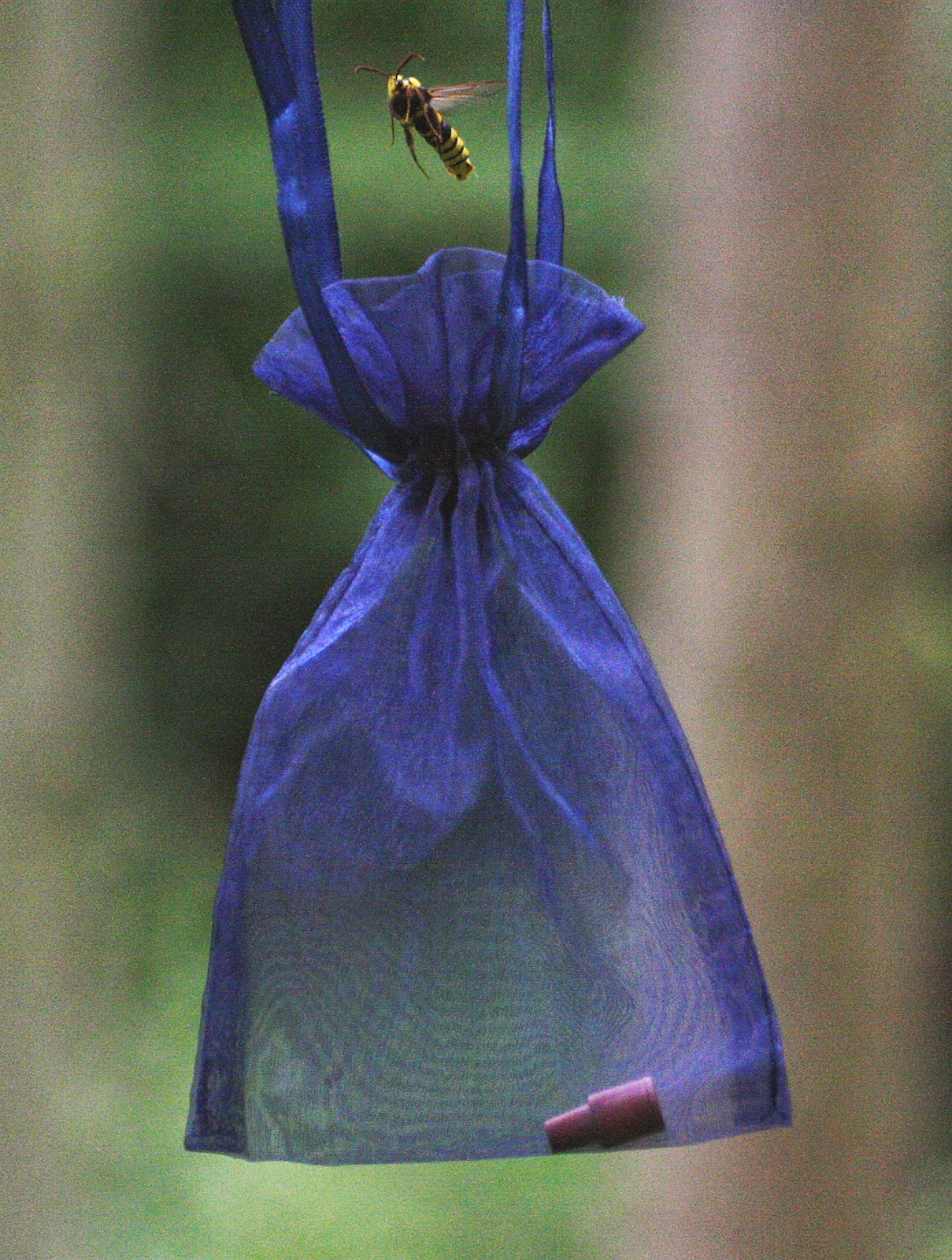
The method is simple: Visit some poplars on a warm day with light breeze between mid May and mid June. Hang the lure and wait. And it was that simple. I attracted hornet clearwings at 3 out of the 4 spots I tried, and it only takes 5 - 10 minutes to bring them in. I had 3 or 4 females and one (much smaller) male. Enjoy the pics!


The Bad

There were some big ol' evil-looking mossies at the site, despite it being the middle of the day. They plagued me here and forced me to beat an early retreat but not before leaving me with a few fiercely itchy bites, one of which ballooned as I had an uncharacteristic allergic reaction to it next morning. I usually wear insect repellant if there are mosquitos about as I hate them with a vegeance, but putting on chemical insect repellant while standing by a chemical insect attractant - well it's not the brightest idea, is it?

The Ugly

Well the photo says it all. Here's me with my prize catch, just before release. On the other hand the insect itself, one of the larger females, is really quite beautiful.


Friday, 6 June 2014

Sexy Beast!

Firstly, if you have found this on a Google search and were hoping for a pic of Ray Winstone in his underwear, then I'm sorry to disappoint you. This post is about birds folks, and starts with one of the finest Avian offerings from the Mediterranean region (from a UK twitcher's perspective), a great big raptor with a staring yellow eye, vaguely osprey-like colour scheme and a penchant for snakes.

The popular eagle in Dorest last weekend was first found by someone on a guided walk in Wareham Forest. They pointed to the large raptor sat in a pine tree and enquired as to its identity. The guide, a local birder from Upton, Poole, must have nearly fainted. He recognised it as a short-toed eagle, and within an hour or so a fantastic photo was circulating on Twitter with the news that it had been present just 10 minutes, before heading off east.

I missed some 20 or so potentially new birds during my backpacking adventures downunder in 1999-2000 and though I have got back most of them since, the biggest prize - short-toed eagle - has never been
within reach. There have been a few claims since the first British record on Scilly in 1999, resulting in an accepted bird in Devon in 2011, and the fascinating unravelling in a classic Birdforum thread of
a hoax attempted by teenage birder Joe Pell - some excellent detective work paving the way for the now regular scrutiny given to suspicious online photos which might relate to a hoax, and which has produced experts in botany, fence posts and barbed wire that can smell a rat at a hundred paces from their laptop. Sherlock Holmes himself would be proud of some of the efforts in the 'Birdforum Courtroom' and to those that have helped expose such dubious goings on, I salute you.

Thoughts of a hoax were quickly dispelled however, when it emerged that other observers had seen this latest bird and that there had even been a possible sighting several days earlier. And the guide who put out the news had a solid reputation too, this was looking like the real deal! The hours passed, then suddenly there was another sighting nearby - the bird was lingering, and before I knew it came the best news of all - it had been relocated sitting in a tree!

Suddenly Dorset seemed a long way away from Cambridge, but despite leaving late in the day at 5.30, by 8pm I was watching it with just 35-40 or so birders, and these were mainly locals. Where was everyone?
It was a beautiful location and we watched the bird at a range of about a quarter of a mile, until the mosquitos and the need to find accommodation forced me to leave, though not before a nice flypast by a male nightjar.

A quick stay at a local YHA and I was back for seconds. It was a gorgeous day and several hundred people - containing many familiar faces - were watching the eagle.


 Med gulls passed over, and the air rang out with the song of tree pipits and Dartford warblers. The camararderie was good and soon everyone started to move closer. We eventually enjoyed views to just 150m range. The bird wasn't bothered at all. Then, just after 10am after a marathon 17 hrs sat (mostly) in the same tree it did the decent thing and took off to the onslaught of an army of firing camera shutters. It circled for a while and slipped away to the south west. It was not seen again. I returned home via the New Forest where distant goshawks and a single honey buzzard kept up the raptor theme. I was smiling most of the way. A ghost had been laid to rest!


Just the day after seeing the eagle I was off to Norfolk for my second spectacled warbler. I'd missed the female black-headed bunting in Norfolk, which had departed overnight after a stay of several days,
but you can't have everything. Norfolk listers had been denied the last 'speccy' in the county - a one day suppressed bird in 2011 on Scolt Head Island, so this one - destined to become the 8th record for Britain -  was very much appreciated.

It showed mainly in rose bushes at about 30 - 40m range, and delighted a whole new generation of birders who had not previously seen the species in Britain. It seems embarrassing now that despite having seen
10 Sylvia species in Norfolk (including such gems as Desert, Sardinian & Ruppell's) I have yet to catch up with Dartford warbler in the county!


Compared to the eagle, everything else in May paled into insignificance...sightings were unremarkable with perhaps the highlight for me a local pair of stilts on territory for a while - what became of them I'm not sure, and if I did know I may not be allowed to post the details. But with well-publicised pairs nesting this year in Kent & Sussex it's quite possible there are other breeding attempts going on elsewhere in the country. I might even take a trip down for the Kent ones as fluffballs elevated on stilts sound rather endearing.

A few ecology field surveys kept me busy, with particular focus on bats and great crested newts. At one site near the M25 we caught more than 50 of these, including 9 in one bottle trap. For a rare species GCN seems bloody common - but apparently their protected status reflects more on their rarity across Europe as a whole, though perhaps it's partly down to new taxonomy with new species such as Italian crested newt now split and presumable rendering GCN rarer and more restricted on the continent. Anyway, not a subject I can pretend to know much about, though training for a newt license could be on the cards for next year - watch this space.


With the highlight of the bat surveys being a little owl (or two) it was left to a couple of trapping sessions with local bat groups to produce true Chiropteran inspiration - sessions at Finemere Wood, and Priory CP yielded a succession of the commoner species (both pips plus Daubenton's) in the hand along with 2 individuals of the rather rare Bechstein's bat - complete with attendant film crew from Countryfile. The latter made it (at times) difficult to get near the tiny stars of the show but good views of the delectable Ellie Harrison made up in part. On this occasion I chose to stand well behind the cameras - just in case someone thought I actually knew something about bats!

Bechstein's bat
Common pipistrelle
Soprano pipistrelle

Saturday, 3 May 2014

Another Fair Isle Double!

The second half of April 2014 was spiced up with a few birding sojourns close to home. A day out in the Brecks produced a few of the region's specialities and views of the male two-barred crossbill at Lynford; a mini twitch to the Cam Washes yielded a pair of red-rumped swallows, my first multiple of this species in Britain; a half day at the Ouse Washes produced a few migrants and some decent passage waders; and a trip out to Baldock produced a fine male 3rd calendar year hen harrier, albeit not the Monty's it had been I/D'd as prior to my visit.

The first big bird of the spring often breaks around the end of April or beginning of May. We've already had this in the form of the excellent crag martin at Flamborough. The next biggie was to be an island job, Fair Isle to be precise, a location temporarily home to a fine male Cretzschmar's bunting, and like the martin, a massive potential grip-back for me!

There has been just one truly twitchable Cretzschmar's, one for 3 days on North Ron a few years ago, a bird likely to have generated more spelling mistakes in birders' notebooks than perhaps any other. All records have come from the Northern Isles, making it a much prized rarity indeed. This latest Cretz was not a bird to miss, not least because there was some serious back-up material on the island in the form of a fine male Caspian stonechat, a potential new bird for me and a likely future split. And like the bunting it would represent just the fifth record for Britain. It could be just like the Fair Isle double of 2003 when I went for a savannah sparrow and collected my second Sibe rubythroat into the bargain.

This mega bunting was found by ex-warden Deryk Shaw while checking out an RB fly just opposite his own croft. These 2 two birds, together with the stonechat, has taken his 'garden' list to over 150, a list truly rich in terms of quantity yet even more impressive in quality, but that's Fair Isle for you!

Luckily news of the bunting's continued presence broke early on the day I travelled, enabling us to have most of the day on the island. The ever-accommodating obs staff collected us and delivered us to a damp field in the south of the island at Boini Mire. Here the bunting was showing on and off in long tussocky grass. It wasn't particularly close (perhaps 70 – 80 yards) but was a right stunner in a gorgeous orange and blue colour scheme, much brighter than any male ortolan.


With the stonechat just a five minute walk along the road at Lower Leough, we soon headed off to look for it and found it showing like a dream, sometimes down to just a few metres, sporting that great wheatear-esque tail and a handful of other diagnostic features. What a day this was turning into! Birders soon drifted off to check out a couple of nearby short-toed larks, leaving me with the stonechat virtually to myself.


I eventually tore myself away and returned to Boini Mire but the bunting had moved on. I stayed in the general area, checking out a few nearby crofts and fencelines, but couldn't relocate it. I decided not to try for the nearby larks which was perhaps a bad decision, as I heard later that they had been showing well and there was a wryneck close-by too. I also somehow missed Deryk's RB fly, and was later gripped off by some stunning photos. Instead I rambled around checking out the commoner migrants – a few tree pipits were much in evidence among the dozens of meadow; there was a smart male redstart and equally smart male whinchat; lesser whitethroat, white wagtail, brambling and a fly-by redpoll provided further interest.


Around lunch-time I had brief views of the bunting as it flew by me, giving its fairly distinctive 'wip, wip' call, but I immediately lost it to view and couldn't refind it. I continued searching for another hour or two, and managed to kick up a jack snipe and blue-headed wagtail from a ditch in the same field but all too quickly it was time to head home and I was left reflecting on what had been quite a day, one on which Fair Isle yet again had proven that when it comes to rare vagrant birds, there really is nowhere better.